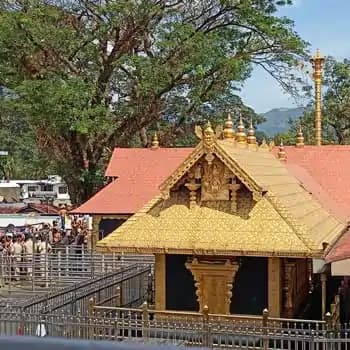
Sabarimala Sastha Temple: History, Rituals, and Spiritual Significance
Sabarimala Sastha Temple in Pathanamthitta district is a world-renowned pilgrimage centre in India. Perched at an altitude of 914 m above sea level, the Sabarimala Temple is situated on the mountain ranges of the Western Ghats amidst eighteen hills. The temple is dedicated to Lord Ayyappan, who, according to the Hindu mythological beliefs, is the son of Lord Shiva and the mythical Mohini, one of the incarnations of Lord Vishnu. This temple is considered the largest annual pilgrimage centre in the world, with an estimated 17 to 30 million devotees visiting the temple every year from all corners of the world.
As the Sabarimala Temple is accessible only on foot, the pilgrims have to walk around 4 Kilometres from Pamba to reach the temple. People, irrespective of their castes and creeds, can visit the temple, except women between 10 and 50 years of age. Mandala Pooja and Makaravilakku are the important festivals of this temple.
History of the Temple:
There lived a king named Rajashekara who ruled the country of Pandalam, and he belonged to the Pandya dynasty. He was a noble king, and the region witnessed a golden age during his reign. But the only disappointment he had was that he was childless and hence had no heir to inherit his throne. The King was a great devotee of Lord Shiva. The hapless King Rajashekara and his queen prayed ceaselessly to Lord Shiva for a child. Around the same time, Mahishasura, a demon king, undertook severe penance, and as a result, Lord Brahma was forced to grant his wish that nobody on earth could destroy Mahishasura. Stimulated by Brahma’s boon, Mahishasura began the systematic destruction of people and pulverised tribes and communities. Realising that only a superhuman power could eradicate the Mahishasura, the devas appealed to Goddess Durga to kill him. After Goddess Durga killed Mahishasura, the demon king, his sister, Maharshi, set out to take revenge for her brother.
Maharshi secured a boon from Lord Brahma that no one could slay her except the offspring of Lord Vishnu (Hari) and Lord Shiva (Haran). To save the world from complete destruction, Lord Vishnu assumed the female persona of Mohini and wed Lord Shiva. And a child was born out of the union between Lord Shiva and the mythical Mohini, the avatar of Lord Vishnu. And the child was ‘Lord Ayyappa’, who is also known as ‘Hariharan Puthran’, which means the son of both Hari or Lord Vishnu and ‘ Haran’ or Lord Shiva. It was already decided that the child Ayyappa would be placed under the care of Lord Shiva’s childless devotee, King Rajashekara of Pandalam.
One day, on his hunting trip to the forests near River Pampa, King Rajashekara heard an infant's cry from the forest. Following the sound, the King came upon a beautiful child. He was extremely delighted seeing the child and longed to take the child to his palace. Then, a sadhu appeared from nowhere and instructed the King to take the child to his palace. The saint also assured him that the child would alleviate the sufferings of his dynasty, and the King would be aware of the divinity of the child when the boy turns twelve. Soon after the child's birth, his divine parents tied a golden bell (mani) around his neck (Kandan). The sadhu directed the King to name the child ‘Manikandan’ – one with a golden neck, as the child was wearing a gold chain.
The King accepted the child as a divine gift, adopted him as his own son and took him to his palace. He narrated the whole happenings to the Queen, and they both believed that they had been blessed by Lord Shiva himself. After some years, the Queen gave birth to a boy child who was named Raja Rajan. Both Ayyappa and Raja Rajan grew up as princes, but Ayyappa excelled in martial arts and the knowledge of various "shastras" and surprised his guru with his brilliance and superhuman talents.
After completing his training and studies, when Manikandan offered 'Gurudakshina' (fee) to his master, his Guru, who was aware of the divine powers of Manikandan, asked him to bless his blind and dumb son with sight and speech. Indeed, Manikandan placed his hands on the guru’s son, and immediately the boy gained eyesight and speech.
King Rajashekara wanted Ayyappan to be his successor, but the Queen wanted her own son, Raja Rajan, to be named the King. Therefore, with the help of Diwan (minister) and her physician, the Queen plotted a plan to kill Manikandan. The Queen pretended to be ill and made her physician proclaim that her illness would be cured only by consuming a tigress's milk. When no one could find a solution for it, the brave Manikandan volunteered to go into the forest in search of the tigress's milk.
On the way, Ayyappa met the demon Maharshi by chance, and he slew her on the banks of the River Azhutha, mounted on her chest and commenced a violent dance which reverberated within the earth and the celestial world. Finally, Maharshi realised that the young boy on her was the son of Hari and Haran, and she humbled herself before the young boy and died. Thus, the destiny of Ayyappa’s life was fulfilled. As he still had one major task to accomplish, he proceeded further into the forest in search of the tigress's milk. Manikandan overpowered the tigress and made his way to the Royal Palace, riding the tigress.
Since his life mission had been accomplished, Manikandan told the king that he would have to return to heaven and also asked him to build a temple atop the Sabari Hill, so that the memory of his short but meaningful life could be eternized, and then he disappeared. In due course of time, King Rajashekara completed the construction of the shrine atop the Sabari Hill, known as the Sabarimala Sastha Temple and the idol of Lord Ayyappa, which was sculpted by Lord Parasurama, was installed in the temple on the day of Makara Sankranti.
Every year, over 50 million devotees visit the Sabarimala Sastha Temple to receive the blessings of Lord Ayyappa. Pilgrimage to Sabarimala is an arduous journey, during which one has to observe a 41-day penance before visiting the temple, trek miles on foot, bathe in the holy river of Pampa, and finally, climb up the steep 18 stairs to reach the Sabarimala temple.
Speciality of the Temple
With an estimated 50 million devotees visiting every year, Sabarimala Sastha Temple is the largest annual pilgrimage centre in the world.
It is believed to be the place where Lord Ayyappa meditated after killing the powerful demoness named Maharshi.
The temple is situated amidst 18 hills.
Women between the ages of 10 and 50 are not allowed to enter the Sabarimala Sastha Temple as the story attributed to Ayyappa prohibits the entry of women in the menstrual age group, since Ayyappa is a Brahmachari (young Ascetic boy).
The devotees who wish to visit Sabarimala Temple are expected to follow a 41-day fasting or Vratham (fasting) prior to the pilgrimage, which begins with wearing a special garland made of Rudraksha or Tulasi beads.
Aravana Payasam and Unniyappam are the main prasadam at Sabarimala Temple.
Every night before closing the temple door, Harivarasanam is recited.
Neyyabhishekam is a significant ritual of this temple, which involves pouring sacred ghee on the idol of Lord Ayyappa, which is brought by the pilgrims in their sacred bag, which they carry on their heads throughout their journey from their house to the temple, and it is called Irumudikettu.
Timings: 3 AM to 1 PM and 3 PM to 11 PM
Festivals in the temple
The most important festival of Sabarimala Sastha Temple is Makara Vilakku, which begins on the day of Makara Sankranti, which is the day when the sun is at the summer solstice. According to legend, it is on this day that the idol of Dharma Shastha was enshrined in the Sabarimala Temple.
Onam, Mandala Pooja and Vishu Vilakku are the other important festivals celebrated at this temple.
Dress Code to visit the temple:
Devotees to Sabarimala wear blue, black or saffron-colored costumes. All the pilgrims have to carry an Irumudiketu, a bag that contains a coconut filled with ghee, puja materials, rice and banana, which will be folded into two halves and is carried on one's head. As a token of devotion, all the devotees must chant "Swamiye Saranam Ayyappa", meaning Ayyappa is my saviour.
Best Time To Visit
From the third week of December to the last week of January is regarded as the most auspicious time to visit Sabarimala Sastha Temple. This is the time devotees throng to the temple to catch a glimpse of the sacred and mystical Makara Jyothi that appears on the 14th of January every year in the hillock nearby called Ponnambalamedu, and is probably the most crowded time at Sabarimala.
How to Reach Sabarimala Temple:
- By Air: Kochi and Thiruvananthapuram International airports are the nearest airports to Sabarimala Sastha Temple. Pilgrims who are flying into Kochi will have to travel about 160 Km by road, and those reaching Thiruvananthapuram by air will have to travel about 170 Km by road in order to reach the Sabarimala Sastha temple.
- By Rail: Kottayam, Thiruvalla and Chengannur are the nearest railway stations to Sabarimala Sastha Temple, which are about 90 Km away. Pilgrims who are coming from places outside Kerala, like Delhi, Mumbai, Mangalore, Bangalore, Coimbatore, and Hyderabad, can disembark at Kottayam, Thiruvalla or Chengannur Railway Station for easy access to the Sabarimala temple.
- By Bus: The majority of pilgrims to Sabarimala arrive by road. Pilgrims coming from Alleppey can reach Sabarimala by road through the Chanaganassery-Erumeli route. They can also proceed through Thiruvalla, Kozhencherry and Pathanamthitta, which is about 125 Km by road to reach Sabarimala.

 English
 Chinese (Simplified)
 Dutch
Dutch French
 German
 Hebrew
 Italian
 Portuguese (Brazil)
 Russian
 Spanish
 Arabic