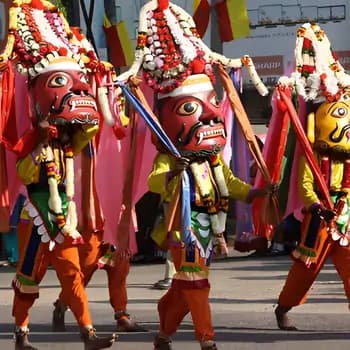
Do you think there is an ideal way to introduce the history and heritage of a place to urbanites? Yes, Somana Kunita. It is the evocative folk art form of Southern Karnataka and conveys an extraordinary message about the ancient village deities of the region.
Somana Kunita is a ritualistic performance staged during temple festivals, prominently glorifying village deities worshipped for centuries. Parts of Southern Karnataka such as Mandya, Hassan, Mysuru, Tumakuru and Bengaluru serve as epicentres of this distinctive tradition. Historically, only male members from the Besta, Kuruba, Okkaliga and Lingayat communities have performed this art, preserving it across generations through devotion and discipline.
A striking feature of Somana Kunita is the elaborate make-up and costume of the artistes. The headgear deserves special mention. Known as banka, it is a triangular structure crafted from sturdy cane sticks, forming the base of the towering headpiece.
The structure is draped in vibrantly coloured sarees, and the headgear or mask is often three times larger than the performer’s head. Anklets and chest bands made of silver and brass adorn the artistes, adding rhythm and grandeur to their movements. The masks typically feature vivid shades of red, soft yellow and serene blue. Traditional percussion and wind instruments accompany the performers, creating a resonant atmosphere during annual fairs and temple festivities.
Somana Kunita is performed with profound religious fervour, accompanied by songs that extol the village deities believed to safeguard communities from misfortune and calamity. Annual temple festivals across Karnataka invariably include Somana Kunita as a sacred ritual, presented with deep reverence and communal pride.
Take the opportunity to witness the vibrant spectacle of Somana Kunita while travelling through the popular destinations of Southern Karnataka.
Beyond its visual splendour, Somana Kunita stands as a living archive of rural belief systems and social cohesion. The performance is not merely entertainment but an offering an act of faith binding the community together. Each movement, drumbeat and lyrical chant carries symbolic meaning, reflecting agrarian life, seasonal cycles and ancestral devotion. In an era of rapid urbanisation, such traditions serve as cultural anchors, reminding younger generations of their roots. Encouraging documentation, academic study and responsible tourism can help preserve this remarkable heritage for the future, ensuring that Somana Kunita continues to thrive with dignity and authenticity.


 English
 Chinese (Simplified)
 Dutch
Dutch French
 German
 Hebrew
 Italian
 Portuguese (Brazil)
 Russian
 Spanish
 Arabic