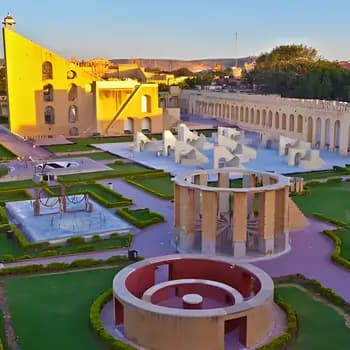
Jaipur's Largest and Well-Preserved Observatory
Located in the heart of Jaipur City, Jantar Mantar is Rajasthan's prominent attraction. It is acknowledged for its historical significance and precise astronomical instruments. Built by Maharaja Jai Singh II, this observatory was designed for making accurate predictions across various domains.
Historical Significance and Architectural Marvel
Ordered in 1728 by Maharaja Jai Singh II completed in 1732, Jantar Mantar stands as a remarkable testament to India's scientific heritage. A visionary ruler with a profound interest in astronomy and mathematics, Jai Singh II constructed five observatories across India, located in Jaipur, Delhi, Ujjain, Mathura, and Varanasi. Among these, Jaipur's observatory is the largest and best preserved.
Constructed primarily from local stone and marble, the site reflects a harmonious blend of Rajput architectural aesthetics and scientific precision. Its monumental instruments are fixed structures, carefully aligned with celestial coordinates, demonstrating advanced knowledge of astronomy in the 18th century.
Recognised as a UNESCO World Heritage Site since 2010, Jantar Mantar is not merely an architectural ensemble but a living symbol of India's scholarly excellence and cosmological curiosity.
Unique Features and Instruments
The observatory houses 19 impressive astronomical instruments, known as "yantras", each designed for specialised observations. The most iconic among them is the Samrat Yantra, the world's largest stone sundial, standing at approximately 27 metres high. It can measure local time with remarkable accuracy, often within a few seconds.
Other notable instruments include the Jai Prakash Yantra, used to determine the position of celestial bodies, and the Rama Yantra, which measures altitude and azimuth. The Misra Yantra combines multiple instruments to identify the longest and shortest days of the year.
Together, these massive geometric forms demonstrate the application of Ptolemaic astronomy and precise observational techniques during the Rajput era, making Jantar Mantar an extraordinary open-air laboratory of celestial science.
Visitor Information
Best Time to Visit: Plan your trip to Rajasthan between September and March to enjoy pleasant weather, ideal for exploring attractions like Jantar Mantar in Jaipur.
Accessibility and Attire: Situated centrally in Jaipur City, Jantar Mantar is easily accessible by various modes of transportation. Wear comfortable cotton clothing and footwear to navigate the complex at a relaxed pace.
Visiting Tips: With nominal charges, visitors can use cameras to capture the intricate instruments and architectural marvels within Jantar Mantar. Allocate 30 minutes to an hour to explore the large complex and marvel at the displays of astronomical instruments and historical artefacts.


 English
 Chinese (Simplified)
 Dutch
Dutch French
 German
 Hebrew
 Italian
 Portuguese (Brazil)
 Russian
 Spanish
 Arabic