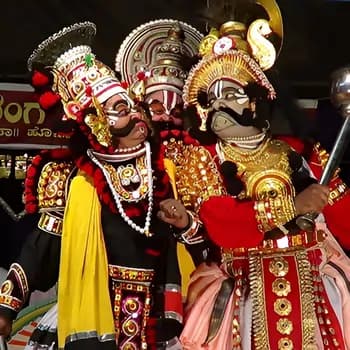
Originating from the South Indian state of Karnataka, Yakshagana is a significant folk art form in Pondicherry. It translates to "Song of the Demi-Gods." Yakshagana is also known by several other names, including Ata, Bayalata, Kelike, and Dasavatara.
Yakshagana typically portrays mythological and religious stories from the Hindu epics, such as the Ramayana and Mahabharata, through a theatrical dance style.
Performances usually take place in a mud-built arena, resembling a theatre equipped with special lighting. Dancers wear elaborate, brightly colored costumes and makeup, including headgear, armlets, belts, and chest covers known as pagade, Buja keerthi, Dabu, and Kavacha.
These are crafted from lightweight wood, adorned with gold foil and mirrors to enhance lighting. A unique aspect of Yakshagana is its incorporation of puppetry, in which puppets wear costumes, ornaments, and makeup similar to those of the live actors.
With their vibrant, luxurious costumes and jewellery, the artists perform scenes from sundown to sunrise. Spectators are captivated by the beautifully enacted tales from Indian epics.
At the very heart of every Yakshagana performance is the bhagavata - the lead singer and narrator, whose powerful vocals and dead-on rhythmic sense steer the story along. Accompanied by traditional instruments like the chande (a pretty straightforward drumming tool) and the maddale, the music all comes together to create an atmosphere that's electric & every bit as intense as the story itself.
The dialogue, by the way, is often entirely improvised, which makes for a real treat. You get to see the performers really let their hair down and show off their wit, spontaneity & deep insight into the stuff of scripture.
In Pondicherry's cultural festivals and temple get-togethers, Yakshagana is this fantastic landmark that sets the tone for Karnataka's rich heritage, while also fitting in perfectly with the diverse artistic vibe of the region - it's a real crowd-pleaser that draws in both dedicated long time fans and casual visitors too.
You really shouldn't miss the chance to catch a Yakshagana show while you're in Pondicherry. You'd find it a real highlight of your visit.


 English
 Chinese (Simplified)
 Dutch
Dutch French
 German
 Hebrew
 Italian
 Portuguese (Brazil)
 Russian
 Spanish
 Arabic