

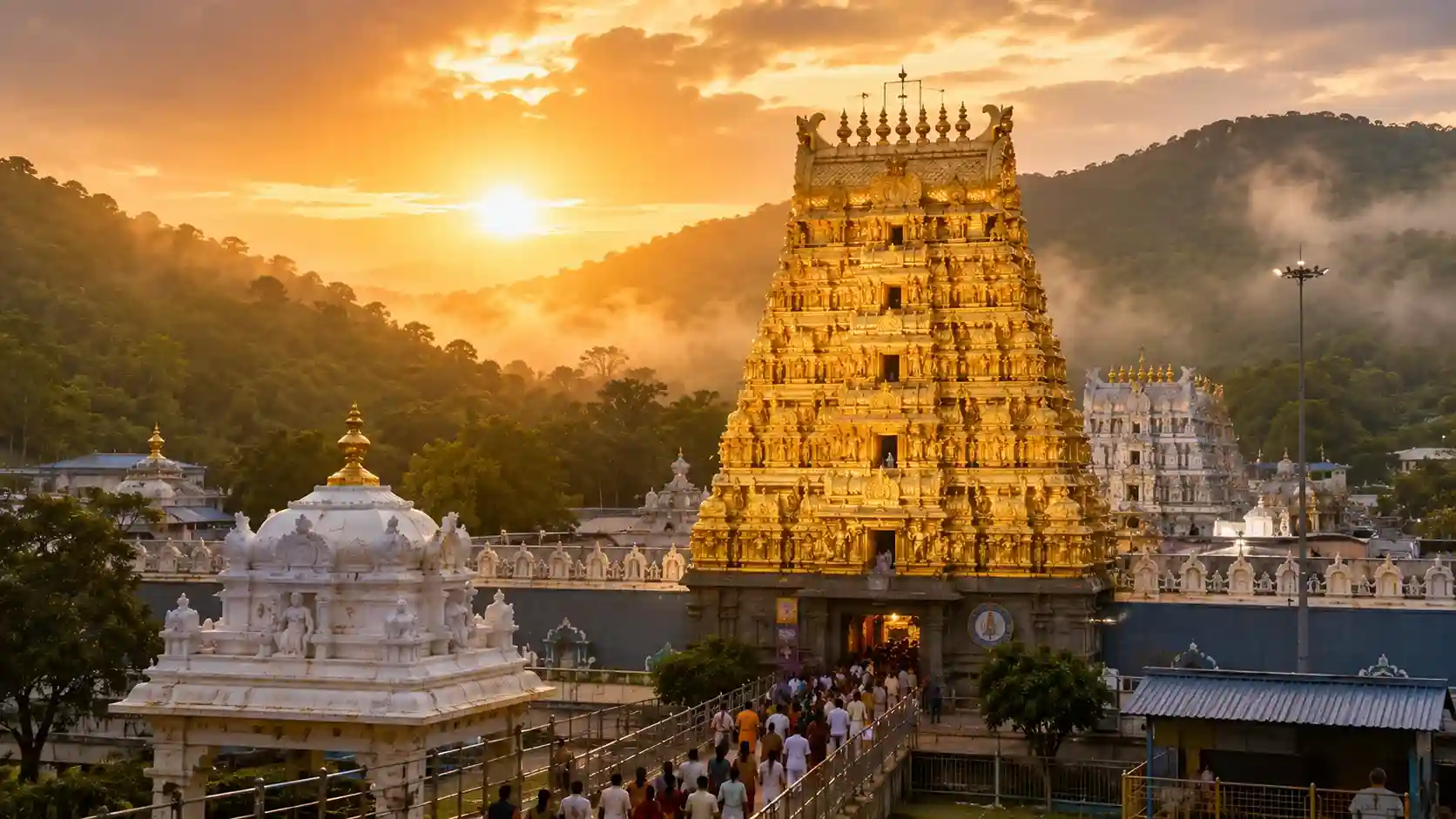
There are places on this earth that don’t just feel holy; they feel alive with something ancient and unseen. Tirupati Balaji is one of those places. The moment the bus/taxi rounds the last bend in the Tirumala hills and the golden gopuram comes into view through the mist, something shifts inside you. This post on a complete guide to Tirupati Balaji Darshan is a good read if you’re willing to explore this holy temple.
Every year, more than 50 million people take the Tirupati temple tour. That makes Tirupati not just one of the most visited religious sites in India but one of the most visited on the entire planet. And yet, for all its fame, first-time visitors often turn up underprepared; they are unclear on how to book, what to wear, how long to wait, or what actually happens inside.
This Guide to Tirupati Balaji Darshan is here to help first-time visitors plan a peaceful and hassle-free pilgrimage. By the time you finish reading it, you’ll know exactly what to do, when to go, and how to make your darshan as peaceful and meaningful as it deserves to be.
Who Is Lord Venkateswara and Why Does Tirupati Matter So Much?
Before diving into logistics, it helps to understand why this temple draws such extraordinary crowds.
The presiding deity here is Lord Sri Venkateswara, an incarnation of Lord Vishnu. According to Hindu belief, Lord Vishnu took this earthly form specifically to bless humankind during the Kali Yuga, the current age of spiritual struggle that we are all living through. Because of this, the temple is widely known as Kaliyuga Vaikuntam, meaning “the Heaven of Kali Yuga,” and the Lord himself is called Kaliyuga Prathyaksha Daivam, the “visible God of the Kali age.”
The idol of Lord Venkateswara is believed to be a Swayambhu, meaning it self-manifested rather than sculpted by human hands. He stands in a graceful posture with four arms; one raised in blessing, one resting on his thigh, and the other two holding the divine conch and chakra. He faces east, and the darshan (the sacred sight of the deity) is considered an act of grace so powerful that it is said to wash away the sins of countless lifetimes.
The Tirumala hills themselves rise to 853 metres above sea level and form seven peaks, said to represent the seven hoods of Adisesha, the divine serpent upon whom Lord Vishnu rests. The temple sits on the seventh and highest of these peaks, Venkatadri, on the southern banks of a sacred water tank called Sri Swami Pushkarini.
Ancient texts, including the Rig Veda and Sangam poetry, refer to the sanctity of this site, and rulers of the Pallava, Chola, Pandya, and Vijayanagara dynasties contributed to the temple’s construction and expansion over the centuries.
The great Vijayanagara king Krishnadevaraya was among the most generous patrons; his gold, gems, and architectural additions still define much of what you see today.
What Is Darshan? What Types of Darshan Are Available?
“Darshan” means the act of seeing the deity. In Hindu tradition, it is not just you looking at God, it is God seeing you. That mutual exchange is considered a blessing in itself.
At Tirupati, the Tirumala Tirupati Devasthanams (TTD), the administrative body, manages the temple. The body has organised darshan into several categories to handle the enormous daily footfall, which regularly exceeds 70,000 to 100,000 devotees. In this Guide to Tirupati Balaji Darshan, learn about the different darshan types available for devotees.
1. Sarva Darshan (Free Darshan/Slotted Sarva Darshan)
It is a free darshan, open to all devotees regardless of income or background. It is the most democratic and perhaps the most spiritually humbling option, you queue alongside people from every walk of life.
However, “free” doesn’t mean “quick.” On busy days, the wait can stretch anywhere from 10 to 20 hours. TTD has introduced a Slotted Sarva Darshan (SSD) system that lets you book a time slot online in advance through the official TTD website, significantly reducing uncertainty and making planning easier. Slots can also be obtained at the Vaikuntham Queue Complex in Tirupati town.
Those who walk up the hills via the Alipiri Mettu or Srivari Mettu footpaths are eligible for a special Divya Darshan, a dedicated free darshan lane. It is a good option for physically fit devotees who wish to experience the pilgrimage in its most traditional form.
2. Special Entry Darshan (Seeghra Darshan)
It is by far the most popular option for pilgrims with limited time. The ₹300 Seeghra Darshan ticket gives you access to a dedicated, faster queue. It typically cuts the wait down to around 2 to 4 hours, compared to the much longer Sarva Darshan wait.
Each ₹300 ticket also includes one free Tirupati Laddu Prasadam, which is reason enough for many people to choose it. Tickets are released monthly in advance through the official TTD website (www.tirumala.org) and tend to sell out within minutes of release. So, it’s worth having your TTD login ready and your Aadhaar card details to hand when they drop.
A word of warning that cannot be stressed enough: never purchase ₹300 tickets through third-party agents or unofficial WhatsApp groups. Fraudulent tickets will result in being turned away at the gate.
3. Special Entry Darshan
A newer addition to the darshan options, the ₹500 ticket offers a slightly more organised and comfortable experience compared to the ₹300 route, with shorter queues and better crowd management. Like the ₹300 ticket, it includes Laddu Prasadam and is booked exclusively online through the TTD portal. It is a good option for families travelling with elderly members or young children.
4. SRIVANI Trust Darshan (VIP Break Darshan)
This darshan type is a premium option for those who wish to contribute to a charitable cause while securing a faster darshan. By donating ₹10,000 per person to the SRIVANI Trust (an endowment fund for education and empowerment), devotees receive VIP Break Darshan privileges. It means they can join the darshan queue at designated break points, bypassing the general wait almost entirely.
VIP Break Darshan tickets can be purchased at the Tirupati Airport on arrival, at the JEO office in Tirumala, or through authorised channels. Note that this darshan is occasionally suspended on specific days, particularly during special rituals like Koil Alwar Tirumanjanam or Vaikunta Dwara days. So it’s worth checking the TTD website for updates before your trip.
How to Book Darshan Tickets Online for Your Tirupati Temple Tour
The official booking portal for all paid darshans is www.tirumala.org. Here’s how the process works:
- Create a TTD account: Register with your mobile number and email address, and verify via OTP. Do this well in advance, not the day tickets are released.
- Keep Aadhaar details ready: Every adult devotee must enter their Aadhaar number (or passport number for NRIs) during booking. Children below 12 years of age do not require separate tickets. However, they need to be accompanied by an adult, and age proof may be requested.
- Check the release schedule: TTD typically releases tickets for an entire month in one go, roughly 2 to 3 months in advance. The release is at 10:00 am on the designated day, and tickets often sell out in minutes. Set a reminder.
- Select your date and time slot: Early morning slots (before 7 am) are generally preferable, as the temple atmosphere is serene and crowds tend to be lighter.
- Pay and download: Complete payment via UPI, net banking, or card. Download the confirmation PDF, print a physical copy, and carry it along with every pilgrim’s Aadhaar card on darshan day.
- Report early: Arriving at least one hour before your designated slot is strongly recommended. Late arrival can result in forfeiture of the slot.
The Dress Code: What to Wear (and What Not to Wear)
No Guide to Tirupati Balaji Darshan would be complete without explaining the temple dress code. The temple maintains a strict dress code with no exceptions. Turning up in the wrong attire means being turned away at the queue entrance, which is a deeply frustrating experience that is entirely avoidable.
- For men: Traditional Indian wear is mandatory. A dhoti with an angavastram (upper cloth), kurta-pyjama, or any formal Indian attire is acceptable. Shorts, Bermudas, and T-shirts are strictly prohibited.
- For women: A saree (with blouse), half-saree, or churidar/salwar kameez with a dupatta is required. Western outfits like jeans, skirts, and sleeveless tops are not permitted.
Important: Mobile phones and cameras are not allowed inside the temple complex. Secure them at the cloakroom facilities available near the entrance before joining the darshan queue. Carry only what you need: a light bag, your ticket, ID proof, and perhaps a small bottle of water.
Temple Timings
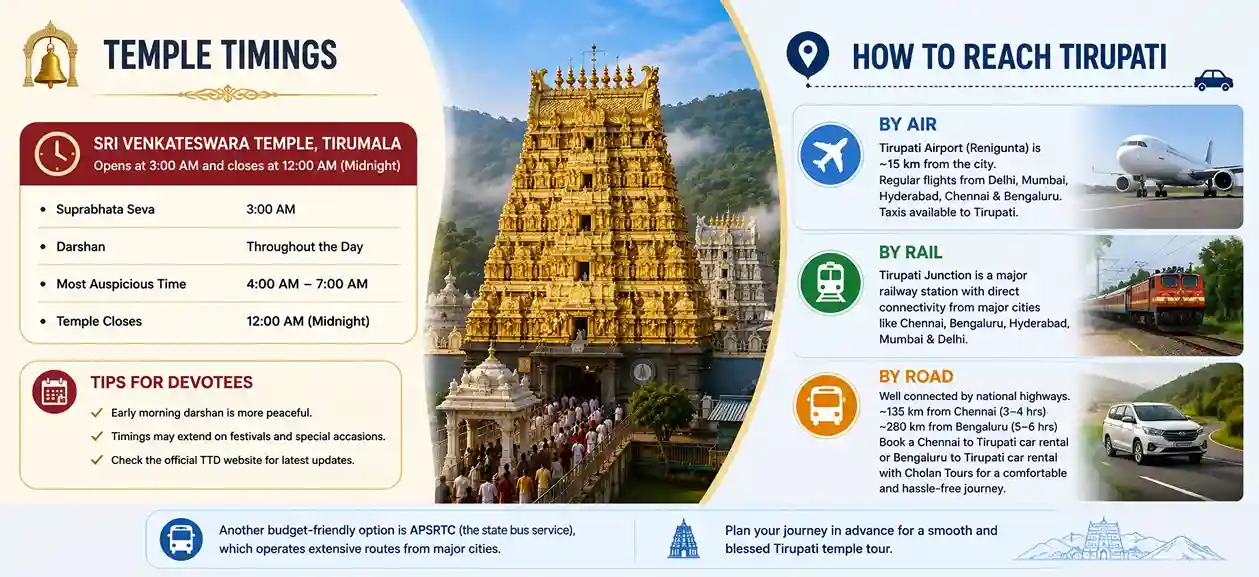
To ease your Tirupati temple tour, knowing temple timings is essential. The Sri Venkateswara Temple opens at 3:00 am for the Suprabhata Seva, a morning wake-up ritual performed for the deity. It remains open until midnight (12:00 am) on regular days. The opening hours extend a little on peak days and festivals.
Darshan is generally available throughout the day, but the experience is widely considered most spiritually potent in the early morning hours. If you have a choice, book a slot between 4:00 am and 7:00 am and arrive prepared for the quiet, incense-filled dawn atmosphere of Tirumala.
How to Reach Tirupati
Tirupati is remarkably well-connected for a hill town, which is partly what makes it so accessible to so many people.
- By Air: Fly to Tirupati Airport (Renigunta), which is around 15 kilometres from the city. This airport has regular flights from Delhi, Mumbai, Hyderabad, Chennai, and Bengaluru. Taxis from the airport to Tirupati town cost roughly ₹300 to ₹500. With advance booking of a car rental in Tirupati, you can easily move to the city from the airport.
- By Rail: Board a direct or connecting train to Tirupati Junction, which is a major railway station. This station has direct train operations from the cities Chennai, Bengaluru, Hyderabad, Mumbai, and Delhi. This is one of the most popular and economical ways to arrive. From the station, use public transport or private car for your transfer to the city, hotel, or the temple area.
- By Road: Tirupati is connected by national highways and is easily drivable from Chennai (approximately 135 km, around 3 to 4 hours) and Bengaluru (roughly 280 km, around 5 to 6 hours). Travellers looking for a comfortable road journey can book a Chennai to Tirupati car rental or Bengaluru to Tirupati car rental with Cholan Tours for a smooth and convenient temple trip. Another budget-friendly option is APSRTC (the state bus service), which operates extensive routes from major cities.
Getting up to Tirumala
The actual temple is 22 kilometres uphill from Tirupati town. APSRTC buses run frequently from the Tirupati bus stand to Tirumala and are the most common mode of transport. Taxis and private vehicles are also available. Devotees who wish to walk can take the Alipiri Mettu path (approximately 11.5 km, 3,500 steps) or the Srivari Mettu path (approximately 4 km). Walking pilgrims receive a token for Divya Darshan upon reaching the top.
When to Take the Tirupati Temple Tour?
The Tirupati Tirumala Temple is open year-round. But your experience can vary depending on when you go.
Winter (October to February)
It is widely considered the ideal window. The weather across the Tirumala hills is pleasantly cool (temperatures ranging from 15°C to 25°C). So, waiting in the queue and walking through the queue complexes are more comfortable. It is also when the famous Brahmotsavam festival takes place, usually in September or October. This festival draws enormous crowds but also delivers an unparalleled spiritual spectacle.
Summer (March to May/June)
The weather is hot but there are notably fewer crowds. So, queues are shorter. It can be a smart time to visit if you prioritise a quieter darshan over comfortable temperatures.
Monsoon (July to September)
During the monsoon season, the Tirumala hills transform into lush, misty greenery, with small waterfalls appearing along the forested slopes. The atmosphere is beautiful and atmospheric, humidity aside, and crowds tend to be lighter than in the peak winter months.
For the absolute smoothest darshan experience with the shortest possible wait, aim for a Tuesday or Wednesday morning during a non-festival month. It is ideal for February, late August, or September. This combination can reduce waiting time to as little as 2 to 3 hours.
What Happens During the Tirupati Tirumala Temple Darshan
Many first-time visitors feel nervous about what to expect inside the temple. Here is what typically happens:
After your queue is called, you move through a series of increasingly narrow passages within the ancient temple complex. The air thickens with the smell of camphor, flowers, and incense. You can hear chanting growing louder. The pace of movement is managed by staff throughout.
When you finally enter the inner sanctum, the Garbhagriha, known as Ananda Nilayam, with its famous golden vimana (tower) rising above, the darshan itself lasts only a few seconds. Lord Venkateswara appears before you, immense and magnificent, adorned in silks and jewels. Priests chant, and a bell rings. And then you are guided out.
It sounds brief. And it is. But something about those few seconds tends to stay with people for a very long time. Many describe it as simultaneously overwhelming and profoundly peaceful. Some cry without understanding why. Others feel a stillness settle over them that persists for days.
After the darshan, you collect your Laddu Prasadam, the famous Tirupati Laddu, which is made fresh in the temple kitchen, blessed, and distributed to devotees. It holds a GI (Geographical Indication) tag and is exclusively available at the Tirumala Temple. Do not leave without it.
The Tonsure Ritual, Offering Hair
One of the most visible and moving practices at Tirupati is the Mokku, the ritual shaving of one’s hair as an offering to Lord Venkateswara.
Devotees offer their hair as a symbol of surrendering the ego, the idea being that the head, which represents pride and identity, is offered to God in an act of complete humility. Hundreds of barbers operate at designated halls within the temple complex, and the ritual is carried out hygienically and efficiently. The donated hair is later auctioned by TTD, generating significant revenue that funds the temple’s extensive charitable and educational work.
Both men and women participate. It is an entirely voluntary act, but witnessing it or participating in it can be one of the most unexpectedly moving moments of the entire pilgrimage.
Free Meals, Accommodation, and Other Facilities
The TTD is extraordinarily well-organised in its care of pilgrims and provides a wide range of facilities at little to no cost.
- Free meals (Annadanam): TTD operates large dining halls that serve wholesome, free vegetarian meals to devotees around the clock. The food is simple, nourishing, and cooked in enormous quantities for thousands of people.
- Accommodation: TTD manages a range of accommodations on Tirumala hill, from free dormitories to budget rooms and cottages. You can book one in advance through the official TTD website for your stay during your Tirupati temple tour. The quality is functional rather than luxurious, but they are clean, affordable, and perfectly located.
- Medical facilities: Basic medical care is available within the complex for emergencies. For serious concerns, Tirupati town has hospitals.
- Luggage storage: Secure cloakrooms operate near the temple entrance for storing electronics, bags, and valuables before darshan.
- Plastic-free zone: Tirumala is a plastic-free area. Bring your own reusable bags and avoid single-use plastic items. This rule is enforced.
Other Sacred Spots to Visit in Tirupati Temple Tour
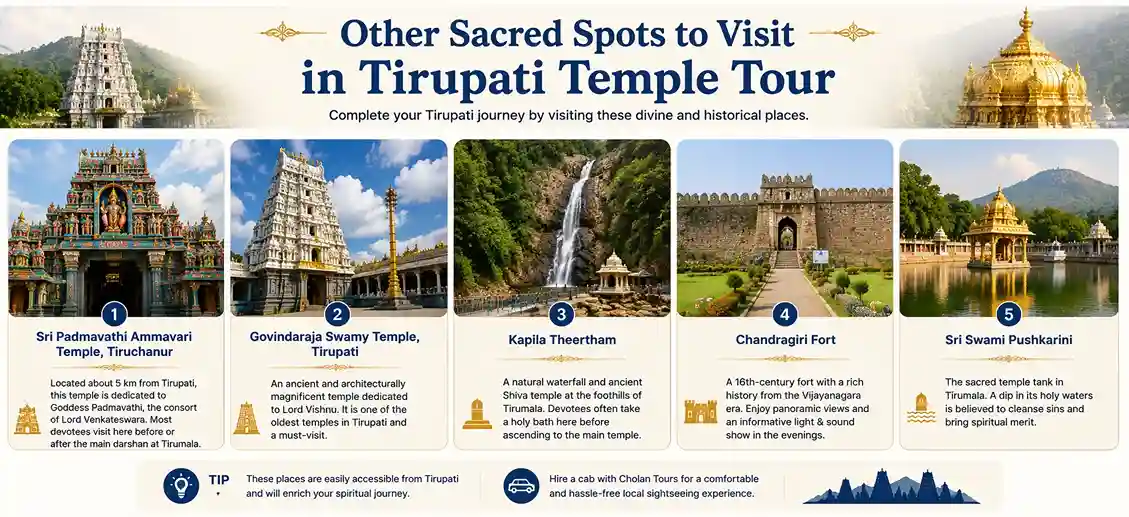
A religious trip to Tirupati is traditionally considered incomplete without visiting a few other nearby temples. Many pilgrims combine Tirumala with a wider circuit, which is why our temple tour packages often pair it with Kanchipuram, Madurai or the Divya Desam route.
- Sri Padmavathi Ammavari Temple, Tiruchanur: Located about 5 kilometres from Tirupati town, this temple is dedicated to Padmavathi Devi, the consort of Lord Venkateswara. Most devotees visit here either before or after the main darshan at Tirumala.
- Govindaraja Swamy Temple: Situated in Tirupati itself, this ancient, architecturally beautiful temple is dedicated to another form of Lord Vishnu and is well worth a visit.
- Kapila Theertham: A natural waterfall and ancient Shiva temple at the foot of the Tirumala hills, where it is customary to take a ritual bath before ascending to the main temple.
- Chandragiri Fort: A short drive from Tirupati, this 16th-century fort offers a fascinating window into the Vijayanagara and later Mughal-era history of the region, with a light-and-sound show in the evenings.
Tirupati Darshan Guide: Practical Tips to Make the Tirupati Temple Tour Smooth
Each one of you wants a hassle-free Tirupati Tirumala Temple tour. Following the tips mentioned below can be useful:
- Create your TTD account well before the ticket release date. Don’t wait until the day tickets open.
- Book only through www.tirumala.org. Third-party agents and unofficial WhatsApp groups are frequently involved in ticket fraud.
- Carry original ID proof matching the name on your ticket; Aadhaar for Indian nationals, passport for NRIs. Photocopies are not accepted.
- Wear traditional Indian attire from the start. Don’t rely on changing at the last minute.
- Arrive at least one hour before your darshan slot. Missing your slot means losing your booking with no refund.
- Leave your mobile phone in the cloakroom. Electronic devices are not permitted inside the sanctum.
- Avoid peak festival dates, particularly Brahmotsavam, Vaikunta Ekadasi, and major public holidays unless you have a VIP or SRIVANI darshan ticket.
- Book TTD accommodation in advance if you plan to stay overnight at Tirumala. Walk-in availability is rarely guaranteed.
- Keep your laddu ticket safe after darshan. You’ll need it to collect your prasadam.
- Be patient and respectful. The queues can feel long, and the crowds can feel overwhelming. Remember where you are and why you came.
Conclusion
We hope this Guide to Tirupati Balaji Darshan helps you plan a peaceful, organised, and spiritually fulfilling temple journey. For millions of people, it is a life’s promise kept, a moment of reckoning, or the beginning of something they cannot yet name. The system around it, the tickets, the queues, the dress code, the early mornings, etc. can feel bureaucratic from the outside. But once you’re inside those ancient walls, none of that really matters.
What matters is that moment when the crowd parts, the chanting rises, and for a few brief seconds, you are standing in the presence of something that has drawn human beings to this hill for more than a thousand years.
Go prepared. Go with patience. And go with an open heart. At Cholan Tours, we can help you make your trip easier and smoother with our Tirupati tour packages. On your request, we will include everything you need: accommodation, local transfers, darshan tickets, etc. Contact us to discuss it.
FAQs
Q1. How can I book Tirupati Balaji darshan tickets online?
Visit the official TTD website to book Tirupati Balaji darshan tickets online. After login, choose a slot, darshan type, fill the requisite details, and pay the fee. To make the booking smooth, create your TTD account in advance and keep the details of needed documents handy – Aadhaar or passport.
Q2. What is the best time to visit Tirupati Balaji Temple?
You should visit Tirupati Balaji Temple from October to February. During these months, the weather is cool and comfortable for waiting in the long queue. For shorter waiting times, choose weekday mornings, particularly Tuesday and Wednesday.
Q3. Is there any dress code for Tirumala Tirupati Temple darshan?
Yes, there is a strict traditional dress code. As a visitor, you need to follow before entering the Tirumala Tirupati Temple complex for darshan. Wear a dhoti or kurta-payjama if you are a male. As a female, you need to put on salwar kameez or a saree. Never wear Western outfits.
Q4. How long does Tirupati Balaji darshan usually take?
The waiting time for Tirupati Balaji darshan depends on the darshan type you choose. With Sarva Darshan, it can be longer than 10 hours. However, special entry darshan tickets can help you execute your Tirupati Balaji darshan in 2 to 4 hours.