

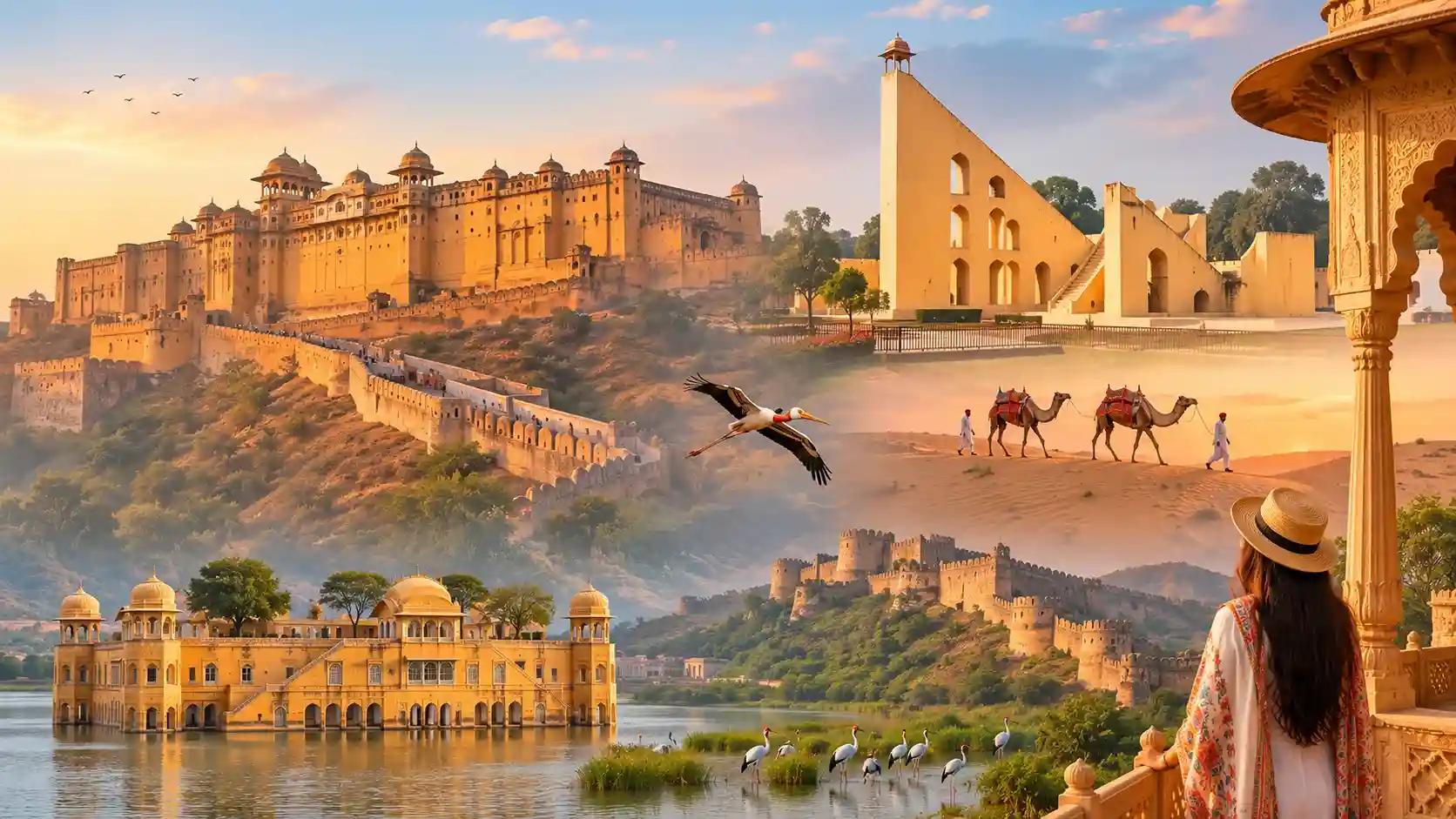
Rajasthan is a land of endless dunes, royal palaces, colourful festivals, and fascinating stories. It is a living museum with remarkable architecture and centuries-old traditions. From hill forts to scientific and astrological points, there are 9 UNESCO World Heritage Sites in Rajasthan.
These world heritage sites in Rajasthan are recognised by UNESCO for their immense contributions to world history, science, conservation, and architecture, as well as their exceptional beauty.
Visiting these Rajasthan world heritage sites will help you understand why this royal state has consistently attracted travellers from all over the world, whether you are planning your first tour to Rajasthan or returning to explore its hidden gems again.
This blog post briefly explains 9 UNESCO sites in Rajasthan, including the best time to visit, opening hours, entry fees, locations, and how to reach them, after having a look at the list. Reading this post will help you maximise your Rajasthan trip experience this year or forthcoming ones. Travellers planning a heritage-focused holiday can explore Cholan Tours’ Rajasthan tour packages for customised itineraries covering Jaipur, Jaisalmer, Chittorgarh, Ranthambore, Kumbhalgarh, and other historic destinations across the state. So, keep reading it till the end.
List of UNESCO World Heritage Sites in Rajasthan
Before learning about them, have a close look at the list of world heritage sites in Rajasthan in the table mentioned below:
| UNESCO Sites in Rajasthan | Location | UNESCO Recognition Year | Original Construction Year | Famous For |
| Jantar Mantar | Jaipur | 2010 | 1727 AD | 19 architectural astronomical instruments |
| Keoladeo National Park | Bharatpur | 1985 | 1976 | More than 300 bird species |
| Amber Fort (Amer Fort) | Jaipur | 2013 | 15 Century AD | Perfect combination of of Hindu-Rajput and Mughal architecture, Sheesh Mahal |
| Kumbhalgarh Fort | Rajsamand | 2013 | 15 Century AD | A massive 36 km defensive wall |
| Chittorgarh Fort | Chittorgarh | 2013 | 7th Century AD | Victory Tower |
| Ranthambore Fort | Sawai Madhopur | 2013 | 944 AD | Ancient temples, tiger reserve |
| Gagron Fort | Jhalawar | 2013 | 7th Century (Beginning), 1195 AD (Core Establishment) | Unique water fort, Surrounded by the Ahu and Kali Sindh rivers |
| Jaisalmer Fort | Jaisalmer | 2013 | 1156 | Medieval architecture, Golden Fort |
| Jaipur City | Jaipur | 2019 | 1727 | Pink City, First planned city |
Top 9 UNESCO Sites in Rajasthan
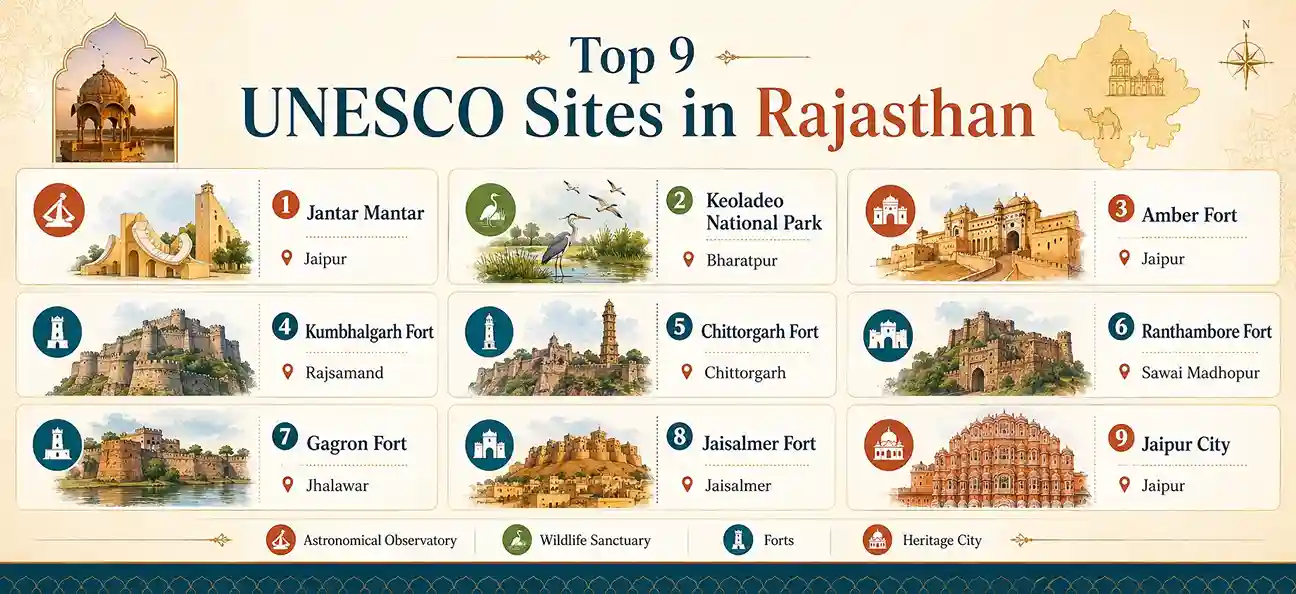
There are 3 primary categories of Rajasthan World Heritage Sites: historic & hill forts, astronomical & scientific landmarks, and natural wildlife sanctuaries. Here, learn about all of them with their location, opening hours, entry fees, best time to visit, and how to get there.
1. Jantar Mantar
Jaipur’s Jantar Mantar is a globally recognised UNESCO World Heritage Site in Rajasthan. Built by the astronomer king Maharaja Sawai Jai Singh II, it is the largest of the five astronomical observatories constructed across North India. The complex functions as an open-air architectural museum housing 19 massive stone instruments designed to calculate time, map star positions, and predict eclipses with incredible accuracy using only the naked eye.
- Location: Near City Palace, Gangori Bazaar, Pink City, Jaipur.
- Opening Hours: 9:00 am to 6:30 pm on all days.
- Entry Fees: INR 50 for Indians and INR 200 for foreigners. INR 20 for Indian students and INR 100 for international students with a valid ID card.
- Key Attractions Inside Jantar Mantar in Jaipur: Vrihat Samrat Yantra, Samrat Yantra, Laghu Samrat Yantra, Jaya Prakash Yantra, Ram Yantra, and Misra Yantra.
- Ideal Exploration Time: 1 to 1.5 hours.
- Best Time to Visit Jantar Mantar in Jaipur: October to March.
- How to Reach: Upon your arrival at Jaipur International Airport or Jaipur Junction, use a cab service in Jaipur for a smooth ride to Jantar Mantar.
2. Keoladeo National Park
Keoladeo National Park, formerly known as the Bharatpur Bird Sanctuary, is among the globally recognised heritage sites in Rajasthan, India. Spanning over 2,800 hectares of wetlands, woodlands, and grasslands, this national park serves as a critical breeding and feeding ground for thousands of resident and migratory birds.
- Location: Bharatpur District, Rajasthan.
- Opening Hours: 6:00 am to 6:00 pm, with slight seasonal changes.
- Entry Fees: INR 75 for Indians and INR 500 for foreigners. Additional charges for specific facilities such as e-rickshaw rides, photography, and safari.
- Key Attractions Inside Keoladeo National Park: 350 avian species of resident and migratory birds, Rock Python Point, Keoladeo Shiva Temple, Nilgai (blue bulls), Sambar deer, Chital (spotted deer), wild boars, and basking monitor lizards.
- Ideal Exploration Time: 4 to 6 hours.
- Best Time to Visit Keoladeo National Park: October to March. August to September for lush greenery.
- How to Reach Keoladeo National Park: Fly to Agra Airport with a direct/connecting flight. The airport is about 56 km from Keoladeo National Park. If you land at Indira Gandhi International Airport (DEL) in New Delhi, use a car rental in Delhi for a smooth 200 km drive to reach this park. For a rail journey, board a direct/connecting train to Bharatpur Junction.
3. Amber Fort (Amer Fort)
Amber Fort, also called Amer Fort, is one of the well-known UNESCO World Heritage Sites in Rajasthan. Located on a rocky hill, it is a unique blend of Rajput and Mughal artistry, built from pink/yellow sandstone and white marble. It is also known as Amber Ka Kila, and Jaipur Fort.
- Location: Devisinghpura, Amer, Jaipur.
- Opening Hours: 8:00 am to 5:30 pm. 6:30 pm to 9:00/9:30 pm for night exploration.
- Entry Fees: INR 50-100 for Indians and INR 500 for foreign tourists. The night entry fee is INR 100 for all visitors.
- Key Attractions Inside Amber Fort: Diwan-e-Aam (Hall of Public Audience), Sheesh Mahal (Mirror Palace), the beautiful Sukh Niwas, the Jai Mandir, Ganesh Pol (Elephant Gate) and the underground tunnels connecting to Jaigarh Fort.
- Ideal Exploration Time: 2 to 3 hours.
- Best Time to Visit Amber Fort: October to March.
- How to Reach Amber Fort: Either fly to Jaipur International Airport or board a direct/connecting train to Jaipur Junction. Upon arrival at the airport or railway station, hire a private taxi service in Jaipur for a smooth drive to Amber Fort.
4. Kumbhalgarh Fort
Known as the Great Wall of India and Mewar’s Eye, Kumbhalgarh Fort is among the well-known World Heritage Sites in Rajasthan. Constructed in the 15th century by Rana Kumbha, this fort is the birthplace of Maharana Pratap. The fort is globally renowned for its massive 36 km defensive wall, the world’s 2nd-longest continuous wall.
- Location: Rajsamand District, Rajasthan.
- Opening Hours: 9:00 am to 6:00 pm. Light & Sound Show: 6:30 pm to 6:45 pm.
- Entry Fees: INR 40 for Indian and SAARC nationals, INR 600 for nationals from other countries. Camera charges: INR 200. Light & Sound Show ticket: INR 100 for Indians and INR 600 for foreigners.
- Key Attractions Inside Kumbhalgarh Fort: The Fortification Wall, Badal Mahal (Palace of Clouds), Neelkanth Mahadev Temple, Vedi Temple, and the Seven Fortified Gateways (Pols).
- Ideal Exploration Time: 2 to 3 hours.
- Best Time to Visit Kumbhalgarh Fort: October to March.
- How to Reach Kumbhalgarh Fort: Take a direct/connecting flight to Maharana Pratap Airport in Udaipur, about 100 km from Kumbhalgarh Fort. Use a Jaipur to Udaipur car rental and extend the ride to the fort, if you land at Jaipur International Airport. For a rail journey, board a train to Falna Railway Station (approx. 85 km) or Udaipur Railway Station.
5. Chittorgarh Fort
Known as the Pride of Rajasthan, Chittorgarh Fort is a UNESCO site in Rajasthan. Spread over 700 acres, it is one of India’s largest forts and features 65 historic structures, including palaces, large water bodies, and temples. The fort is a symbol of Rajput bravery, honour, and sacrifice.
- Location: Chittorgarh
- Opening Hours: 9:00 am to 6:00 pm, last entry 5:30 pm.
- Entry Fees: INR 40 to INR 50 for Indian nationals and INR 200-600 for foreigners.
- Key Attractions Inside Chittorgarh Fort: Vijay Stambh (Tower of Victory), Kirti Stambh (Tower of Fame), Rani Padmini’s Palace, Rana Kumbha Palace, and Meera Temple.
- Ideal Exploration Time: 2 to 4 hours.
- Best Time to Visit Chittorgarh Fort: November to February.
- How to Reach Chittorgarh Fort: Fly to Maharana Pratap Airport in Udaipur with a direct/connecting flight. Udaipur Airport is just about 90 km from the fort. For a rail journey, board a direct/connecting train to Chittaurgarh Junction Railway Station, 4 km from the fort. Arrive at Chittorgarh Bus Stand by a private/public bus from nearby places, then take a private or shared taxi to reach the fort, just 2 km away.
6. Ranthambore Fort
The list of Rajasthan World Heritage Sites is incomplete without naming Ranthambore Fort. Located within the lush Ranthambore National Park, this 10th-century fort is famous as the Hills Fort of Rajasthan, the Tiger Fort, and the Living Fort. It features panoramic views of the jungle with tigers and allied habitats, Trinetra Ganesh Temple, and ancient palaces.
- Location: Inside Ranthambore National Park, Sawai Madhopur, Rajasthan
- Opening Hours: 6:00 am to 6:00 pm.
- Entry Fees: Free for general entry.
- Key Attractions in Ranthambore Fort: Trinetra Ganesha Temple, Hammir’s Court, Badal Mahal, Dullah Mahal, the 32-Pillared Chhatri, and ancient step-wells.
- Ideal Exploration Time: 2 to 3 hours.
- Best Time to Visit Ranthambore Fort: October to March.
- How to Reach Ranthambore Fort: Fly to Jaipur International Airport with a direct or connecting flight. Upon arrival at the airport, use a Jaipur to Ranthambore car rental to smoothly drive to the fort, which is 160 km away. For a rail journey, board a direct/connecting train to Sawai Madhopur Junction, just about 10 km from the fort. You can use public/private bus or shared transportation from nearby places to reach Ranthambore Fort by road.
7. Gagron Fort
Famous as Jal Durg (Water Fort) and as the Only Fort Built without a Foundation, the Gagron Fort is one of the most famous UNESCO World Heritage Sites in Rajasthan. Located in the Jhalawar district of Rajasthan, it is a foundation-less hilltop and water fortress. The Ahu and Kali Sindh rivers surround it. The Gagron Fort offers breathtaking views of natural beauty and features wildlife and Rajput history.
- Location: Jhalawar district, Rajasthan.
- Opening Hours: 9:00 am to 6:00 pm on all days of the week.
- Entry Fees: INR 50 for Indians and INR 100-200 for foreigners.
- Key Attractions in Gagron Fort: Bada Mahal, Rani Mahal, Diwan-i-Aam, Diwan-i-Khas, Rang Mahal, and Sheesh Mahal.
- Ideal Exploration Time: 2 to 3 Hours
- Best Time to Explore Gagron Fort: Mid-October to February/March.
- How to Reach Gagron Fort: There is no direct/connecting flight to Jhalawar. Take a direct/connecting flight to Devi Ahilyabai Holkar Airport (Indore), Raja Bhoj Airport (Bhopal), or Jaipur International Airport. Upon your arrival at any airport, hire a private taxi service for a 6-to-8-hour smooth road drive to access Gagron Fort. For a rail journey, board a direct or connecting train to Jhalawar City Railway Station (JLWC) or Kota Junction (KOTA). From nearby places and cities, you can use a public/private bus or a taxi to reach the fort.
8. Jaisalmer Fort
Often referred to as Sonar Quilla (also spelt Sonar Kella, Golden Fortress), Jaisalmer Fort is a UNESCO World Heritage Site in Rajasthan. It is one of a few living forts in the world. Constructed in 1156, it represents a unique blend of Rajput and Islamic architectural styles. Because of its use of honey-coloured sandstone, it glows beautifully in the afternoon sunlight, attracting visitors, writers, and artists for centuries.
- Location: Trikuta Hill, the Thar Desert, Jaisalmer.
- Open Hours: 24/7, but 9:00 am to 5:00 pm for certain indoor tourist attractions, such as the Royal Palace Museum.
- Entry Fees: Free access to the fort, but INR 50 (for Indians) to INR 250 (for foreigners) for specific key attractions like the Palace Museum and Jain Temples inside the fort. INR 50 to INR 100 for photography.
- Key Attractions in Jaisalmer Fort: Raj Mahal (Royal Palace), Jain Temples, the Laxminath Temple, and four huge gateways – Ganesh Pol, Suraj Pol, Bhoot Pol, and Hawa Pol.
- Ideal Exploration Time: 3 to 4 Hours.
- Best Time to Visit Jaisalmer Fort: October to March.
- How to Reach Jaisalmer Fort: Take a direct/connecting flight to Jaisalmer Airport (seasonal tours) or Jodhpur Airport (year-round trips). These airports have direct commercial flights from major air hubs like Delhi, Mumbai, Chennai, Bangalore, Hyderabad, and Jaipur. For a rail journey, board a direct/connecting train to Jaisalmer Railway Station. You can use Jaipur to Jodhpur car rental and extend the ride to access Jaisalmer Fort if you arrive in Jaipur by air or train.
9. Jaipur City
On the 6th July of 2019, UNESCO announced the inclusion of Jaipur City in its list of World Heritage Sites. With it, the list of Rajasthan World Heritage Sites rose from 8 to 9. Jaipur has left a significant mark on the world’s landscapes with its unique architectural masterpieces. It is one of the first planned cities in India and is globally known as the Pink City.
- Location: Northwest of the country, the capital city of Rajasthan.
- Key Attractions in Jaipur: Hawa Mahal, City Palace, Jal Mahal, Albert Hall Museum, Patrika Gate, and Nahargarh Fort.
- Ideal Exploration Time: 2 to 3 days.
- Best Time to Visit Jaipur: October to March for comfortable sightseeing, city exploration, and outdoor activities.
- How to Reach and Get Around Jaipur: Either fly to Jaipur International Airport or board a train to Jaipur Junction. The airport/railway station has direct flights/trains to metro cities such as Delhi, Mumbai, Kolkata, and Chennai. For a smooth city exploration, use a car rental in Jaipur. Book it as you plan your Jaipur tour.
Explore UNESCO World Heritage Sites in Rajasthan with Cholan Tours
After reading this blog post, you will certainly be excited to visit all these UNESCO World Heritage Sites in Rajasthan. At Cholan Tours, we can help you have a smoother, safer, and more comfortable historical trip with our customised Rajasthan tour packages.
Travellers planning to explore beyond Rajasthan can also check Cholan Tours’ West and Central India tour packages for heritage cities, forts, wildlife destinations, and cultural experiences across the region.
Our exclusively curated Rajasthan trip will include flight/train tickets, comfortable accommodation, sightseeing, local transfers, and even meals, tailored to your travel style, needs, and preferences. Get in touch with us to plan your trip and get a personalised package for your trip to Rajasthan.
FAQs
Q1. How many UNESCO World Heritage Sites are there in Rajasthan?
There are 9 UNESCO World Heritage Sites in Rajasthan: Jantar Mantar, Keoladeo National Park, Amber Fort (Amer Fort), Kumbhalgarh Fort, Chittorgarh Fort, Ranthambore Fort, Gagron Fort, Jaisalmer Fort, and Jaipur City.
Q2. Which is the newest UNESCO World Heritage Site in Rajasthan?
Jaipur City is the newest UNESCO world heritage site in Rajasthan. UNESCO included Jaipur City on its list of World Heritage Sites in 2019.
Q3. Which is the oldest addition to the list of Rajasthan world heritage sites?
Keoladeo National Park is the oldest addition to the list of Rajasthan’s World Heritage Sites. UNESCO included it on the World Heritage List in 1985.
Q4. What are the UNESCO world heritage sites in Rajasthan?
The Rajasthan World Heritage Sites are Jantar Mantar, Keoladeo National Park, Amber Fort (Amer Fort), Kumbhalgarh Fort, Chittorgarh Fort, Ranthambore Fort, Gagron Fort, Jaisalmer Fort, and Jaipur City.
Q5. What is the best time to visit UNESCO world heritage sites in Rajasthan?
Rajasthan is India’s largest desert state. So, the best time to visit UNESCO world heritage sites in Rajasthan is between October and March. During these 5-6 months, the weather is pleasant and comfortable for sightseeing and outdoor activities.
Q6. Can I visit all UNESCO sites in Rajasthan in a single trip?
Yes, you can visit all UNESCO World Heritage Sites in Rajasthan in a single trip. With a customised Rajasthan tour package, you can explore all UNESCO World Heritage Sites in a single trip of 10 to 15 days.