
The first thing one notices about Raulane is not its colours or its sounds but the air itself, as if the village collectively inhales and holds a breath, waiting for something sacred to unfold.
People often describe Raulane as a festival, but it feels more like an arrival, a return- a return to everything the community holds sacred, its land, its stories, its ancestors, and its seasons.
What is Raulane?
Raulane is a spring thanksgiving ceremony practiced in the upper Himalayan belt of Kinnaur, Himachal Pradesh. Villagers believe the Sauni (mountain fairies) stay close to human settlements during the winter months. As spring arrives, the community comes together to thank the Saunis and bid them farewell as they return to the high pastures.
The ritual features a symbolic pair:
- Raula (groom)
- Raulane (bride)
Both roles are played by men chosen from two different village divisions called Saring. Their pairing represents the connection between villagers and the protective spirits. The festival is celebrated collectively, elders guide decisions, families prepare rituals, and every resident participates in some form.
Raulane’s Origins
Traditional Jewellery of Kinnaur
The origins of Raulane are usually traced through a mix of folklore and inherited ritual memory. It is an accumulation of centuries, a blend of folklore, agricultural rhymes, oral narratives, and ritual memory.
Some say Raulane was begun to appease a protective mother goddess who guarded the fields during precarious monsoon months.
Others believe it emerged from older fertility rites connected to sowing and harvesting cycles, slowly reinterpreted through devotional language. Still others connect it to the arrival of a wandering saint who, centuries ago, codified disparate seasonal practices into a unified form of worship.
What makes Raulane exceptional is that no one story dominates. It belongs to the community, flowing through generations, adapting without ever losing its spiritual spine.
Village Preparations
The village lanes are swept more thoroughly, the temples repaired or repainted in sections, and the courtyards washed with generous arcs of water mixed with cow dung and later dusted with soft white rice flour.
Women gather to sift through stored grains, lentils, and spices, because the meals during Raulane require a certain purity and certain ingredients believed to harmonise with the goddess’s energy.
Men take on the responsibility of repairing instruments, arranging seating, or helping clean the village water bodies used for ritual baths.
Rituals Rooted in Nature
At its core, Raulane is not just a celebration of a deity but a reaffirmation of a community’s relationship with land, seasons, and memory.
Silent Invocation
The first formal moment of Raulane is the silent invocation, usually held in the early morning when the sky is still pale and the air almost weightless.
The priests begin a recitation that is neither a chant nor a hymn, but something in between, slow, grounding, and deeply elemental. Those who have grown up with Raulane say this moment feels like someone gently turning a key in your chest, unlocking a season that has been dormant.
The Sacred Water Procession
What follows is a purification ritual deeply rooted in the region’s ecology. A chosen group collects water from a particular river or pond, a source believed to be alive during the festival days.
They walk in a quiet, measured procession carrying clay vessels. The water, once returned, is placed at the temple entrance and blessed before it is incorporated into subsequent rituals.
Sounds of the Festival Rising
Musicians begin testing their instruments in different corners of the village: the steady thump of the dhol, the slow tuning of string instruments, the soft tapping of metal idiophones.
Costumes & Embodied Storytelling
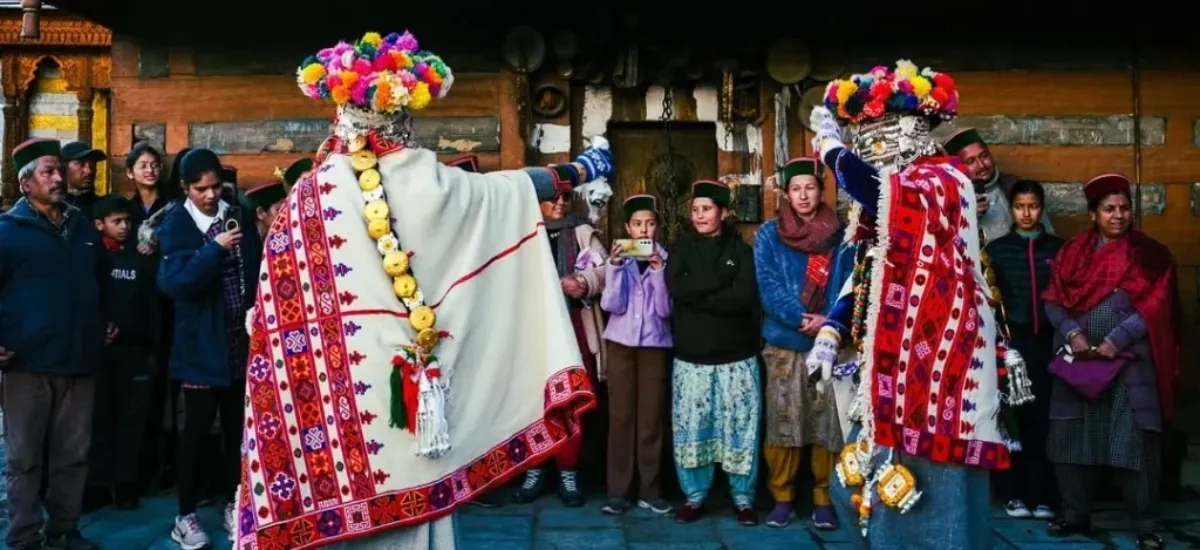
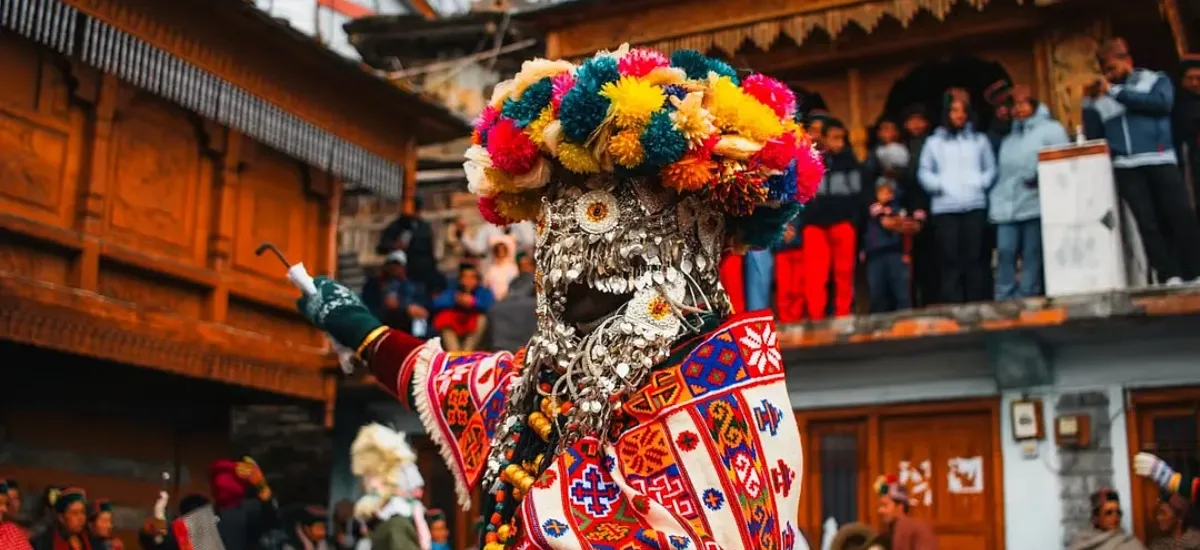
One of the most striking aspects of Raulane is its emphasis on embodied storytelling. Performers are not merely dancers; they are vessels of fairies, carrying generations of narrative through posture, movement, and costume.
Heavy fabrics in deep reds, muted yellows, soot-black, turmeric, and vermillion, also called as pattu, and thepang, with layers of authentic gold and silver traditional jewellery.
The “bride,” or Raulane, wears traditional women’s clothing like a doru (shawl), choli (blouse), and pattu (waist shawl).
Every layer represents a layer of story, while accessories, metal, bead, or cloth indicate lineage, role, and narrative function. Even the application of facial markings is ritualised, done with reverence and precision.
The Performances
When the performances begin, Raulane expands into its full form. The saunis or the fairies are celebrated with dance and soft movements. There is a symbolic marriage between the bride and the groom, and there are festivities all around.
Along with the bride and the groom, the performance also has Zannpundulu, the masked figures who perform to ward off evil spirits.
Throughout the day, daily life and mythology braid together effortlessly, children play near temple entrances, elders exchange family news, and young adults stroll between performances.
When & Where Raulane Happens?
- Season: Late winter to early spring
- Typical Timing: Mostly after Holi
- Duration: 4 to 7 days
- Key Location: Nagin Narayan Temple, Kalpa
Why Raulane Is Suddenly Becoming Famous?
Raulane has recently attracted the attention of travellers, scholars, and cultural enthusiasts. Local youth sharing clips on social media have made the festival visually accessible to wider audiences.
With Himachal Pradesh promoting cultural tourism, festivals like Raulane naturally rise to prominence, though the community continues to prioritise authenticity over commercialisation.
Visiting Raulane: A Traveller’s Guide
Travellers who attend Raulane often describe it as an experience that lingers in their senses long after they leave.
Homestays offer a warm, immersive experience that lets you become part of the community rather than an observer. Visitors should dress modestly, avoid black on certain days, and carry head coverings for temple rituals.
For deeper cultural insight, engage with elders. Their memories reveal how Raulane looked decades ago, with heavier costumes, different chant cadences, and rivers fuller during the monsoon. Their stories enrich the festival beyond what academic texts can offer. Beyond Raulane, travellers can explore Sangla, Chitkul, Kalpa, Kinnauri villages, apple orchards, and local monasteries to experience the broader cultural fabric of Kinnaur.
Tips for Travellers
- Respect village customs and temple boundaries.
- Avoid photographing restricted ceremonies.
- Dress modestly and maintain silence during rituals.
- Prefer guided or community-approved visits for cultural sensitivity.
- Understand that some parts are private and not open to visitors.
Conclusion: Respecting and Preserving Cultural Heritage
Raulane might have gained momentum in recent months, but its essence is as old as time. It is beyond aesthetics, it is culture, it is home, and it is a silent but deep respect of our ancestors and heritage.
Ultimately, Raulane embodies a delicate balance between tradition and living practice. Respecting them means honouring not only their visual and performative beauty but also the values, histories, and spiritual frameworks they represent, ensuring the festival continues to thrive authentically for future generations. Explore Himachal Pradesh Tour Package with Cholan Tours.
Frequently asked questions about Raulane Festival
Q1. Can tourists participate in the Raulane festival?
Yes, visitors are generally welcome to observe the Raulane celebrations, as the festival is community-based and open to outsiders. However, certain rituals, especially those performed inside the temple, are sacred and not open for public participation.
Q2. When is the best time to plan a trip to witness the Raulane festival?
The festival dates vary by village and year, but Raulane usually takes place in late winter or early spring, often shortly after Holi. It’s best to check local schedules in advance when planning your trip.
Q3. Do tour operators offer guided visits to Raulane celebrations?
Some regional tour operators and cultural travel specialists do arrange guided visits to villages during Raulane. These tours help travelers understand the rituals, ensure respectful participation, and provide local insights.
Q4. Are the Raula and Raulane characters played by women during the festival?
No. Traditionally, both the Raula and Raulane roles are performed by men, who dress as the bride and groom for symbolic and cultural significance. Guides often explain these traditions during festival tours.
Q5. What should travelers keep in mind when visiting villages during Raulane?
Visitors should follow local etiquette, dress modestly, avoid entering restricted temple areas, and always seek permission before taking photos. A guided cultural tour ensures a smooth and respectful experience.