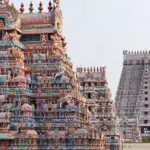


Apart from being powerful administrators and conquerors, the Chola rulers were distinguished architects. They were great supporters of arts and culture. Under their rule, South India saw the construction of some of the most beautiful temples. And those temples are known as Chola temples or Chola dynasty temples.
These shrines represent the best architectural examples of South Indian temples, spiritually charged, mathematically precise, monumental in scale, and political symbols. The Chola period temples are more than religious places; they are living examples of medieval engineering, inscriptional history, urban planning, and sculpture.
Ten Famous Chola Temples
The great living Chola temples are a group of UNESCO-recognised Chola temples that include the Brihadisvara Temple at Thanjavur, the Airavatesvara at Darasuram, and the Brihadisvara at Gangaikondacholapuram. Apart from these three temples, learn about 7 more temples, including their history, architectural design, and other related information.
1. Brihadeeswarar Temple
Rajaraja Chola I constructed the Brihadeeswarar Temple in 1010. Usually referred to as the Big Temple, it represents the zenith of Chola ambition. It ranks first among famous Chola temples.
Under the rule of Rajaraja Chola I, the Chola Empire faced huge geographical expansion through maritime trade and military campaigns. In addition to being a devotional act, the construction of this temple was his political proclamation.
Architectural Features:
- 66-metre or 216-foot vimana
- Use of granite despite the lack of granite in nearby areas
- Has one of the largest Shiva lingas
- Houses a single-stone Nandi statue
- Has an 80-ton capstone (kumbham) at the top
Visiting Time:
- Morning: 6 am to 12:30 pm
- Evening: 4 pm to 8:30 pm
2. Gangaikonda Cholapuram Temple
After his military expansion in the north, Rajendra Chola I built this temple. His victory in the north enabled him to reach the Ganga River and bring its water to the south. Following this victory, he set up a new capital, Gangaiokonda Cholapuram.
This temple was meant to be a replica of the temple built by his father at Thanjavur. Over time, the capital city was destroyed. However, this temple remains safe.
Architectural Features:
- Shorter vimana than the one at Thanjavur. Its height is only 55 metres
- More expensive and adorned sculptural panels
- A unique lion-faced well, known as Simhakeni
- The Shiva lingam is imposing and massive
- Reflects aesthetic evolution
Visiting Time:
- Morning: 6 am to 12:30 pm
- Evening: 4 pm to 8 pm
3. Airavatesvara Temple
The Airavatesvara Temple, built by Rjaraja Chola II in the 12th century, showcases the later Chola period’s artistic evolution. By the end of the 12th century, the Chola Empire started facing challenges. It brought a shift in the construction of this temp. The shift was from the scale to artistic sophistication.
Architectural Features:
- Its front mandapa is a replica of a horse’s chariot
- Its steps produce tonal sounds after tapping, so they are known as musical steps
- Pillars have intricately designed, unique relief panels
- Miniature carvings represent mythological scenes, dancers, and musicians
Visiting Time:
- Morning: 6 am to 12:30 pm
- Evening: 4 pm to 8 pm
4. Nageswaran Temple
This temple, one of the earliest great living Chola temples, faces neglect by casual visitors. Visiting it is essential if you want to learn about temple evaluation during the Chola Dynasty.
Aditya Chola I constructed this temple in the late and early 10th century. It showcases the transition in South Indian architecture, where Pallava architectural experimentation began to mature into a different Chola solidity.
Architectural Features:
- Precise and geometrically balanced design
- Robust axial alignment
- Early use of stone
- Sculptures feature Lord Shiva in several different forms
Visiting Time:
- Morning: 6 am to 12:30 pm
- Evening: 4 pm to 8 pm
5. Kampaheswarar Temple
Kulothunga Chola III constructed the Kampaheswarar Temple. It is a good example of the temple architecture in the late phase of the Chola Empire.
Despite the rise of regional powers, the construction of this temple reaffirms cultural identity and religious authority. The term Kampaheswarar refers to Lord Shiva, who removes all obstacles and fear.
Architectural Features:
- Proportionally refined vimana
- A lot of Shaiva images, including benevolent and fierce forms
- Complicated iconographic panels
- Sound sculptural detailing
- More ornamental and lighter compared to earlier Chola dynasty temples
Visiting Time:
- Morning: 6 am to 12:30 pm
- Evening: 4 pm to 8 pm
6.Adikesava Perumal Temple
The Adikesava Perumal Temple is a Vaishnavite shrine and reflects the spiritual diversity within the Chola Empire. Despite its earlier origins, this temple received Chola renovations and patronage during their rule. The Chola Dynasty favoured both Shaivism and Vaishnavism.
Architectural Features:
- The right combination of Kerala-style and Dravidian elements
- Intricate wooden carvings in ceilings
- Vishnu idols along with Shiva idols
- Diagonal unique tiled roofs
Visiting Time:
- Morning: 5:00 am to 12:00 pm
- Evening: 5:00 pm to 8 pm
7. Koranganatha Temple
The Koranganatha Temple is among the Chola Dynasty temples that offer deep insight into the dynasty’s architectural roots. It was built in the 10th century. At that time, a period of territorial consolidation was going on. The Cholas were asserting their independence from the Pallavas and establishing their own architectural identity. This temple showcases regional craftsmanship.
Architectural Features:
- The use of early granite construction techniques
- Compact sanctum and modest scale
- Minimalist superstructure
- Numerous devakoshta sculptures
Visiting Time:
- Morning: 6 am to 11:30 am
- Evening: 4 pm to 7:30 pm
8. Ranganathaswamy Temple
Constructed and grown under the Chola patronage, the Ranganathaswamy Temple is one of the world’s largest temple complexes. The Vijayanagara rulers and the Pandyas later expanded this temple. However, the Cholas made significant land grants and structural developments.
Architectural Features:
- Huge corridors
- Several concentric enclosures
- Market streets
- Temple tank
- Towering gopurams
Visiting Time:
- Morning: 6 am to 1 pm
- Evening: 3:30 pm to 9 pm
9. Moovar Koil
Constructed in the 10th century, this temple is a fitting reflection of the decentralised phase of temple construction. In this phase, regional elites showed a sound interest in architectural patronage and faced imperial influence. The term Moover Koil translates into the Temple of Three and denotes the three original shrines, of which two survive.
Architectural Features:
- The integration of early mandapas
- Experimentation with granite uses
- Remarkable refinements in sculptural panels
- Transitional superstructure forms
Visiting Time:
- The temple is open to the public throughout the day, usually from 6 am to 6 pm.
10. Subrahmanya Temple
This temple is considered a hidden gem in the Chola-period temples. Built in the 10th century, this temple reflects the refinement of sculptural traditions into a better style. It is smaller in scale. However, this temple shows stunning artistic sophistication.
Architectural Features:
- Highly expressive relief panels
- Elegant proportions
- Dynamic deity representations
- Magnificent devakoshta sculptures
Visiting Time:
- Morning: 6 am to 11:30 am
- Evening: 4 pm to 7:30 pm
Conclusion
The above-mentioned famous Chola temples in India are among the best architectural legacies in the contemporary world. They reflect a golden age of South Indian civilisation.
At Cholan Tours, we can help you explore all ten great Chola temples with our customised temple tours. Based on your convenience and comfort, we can take care of everything from start to finish, including your return journey. Contact us to book a personalised travel package.
FAQs
Q1. What are the great Chola temples?
The great Chola temples are a group of temples constructed during the Chola rule in South India. In total, there are ten, but three of them (Brihadisvara Temple at Thanjavur, the Airavatesvara at Darasuram, and the Brihadisvara at Gangaikondacholapuram) are listed as UNESCO World Heritage Sites.
Q2. What is the best time to visit the famous Chola temples in India?
The best time to visit these temples is from September to February/March. During this period, the weather is pleasant for temple visits and all outdoor activities.
Q3. When should I visit these temples on a day?
In general, Chola Dynasty temples are open all day. However, you should visit them in the morning and evening hours (6 am to 11 am and 5 pm to 8 pm). Temple opening times may vary. Be sure to check the opening hours before your visit.
Q4. Why are Chola temples known for?
They are highly acknowledged for their medieval engineering innovation, uninterrupted ancient ritual tradition, unique artistic excellence, and imperial governance.
Q5. When were the famous Chola temples built?
The Chola rulers between the 10th and 12th centuries constructed them.