
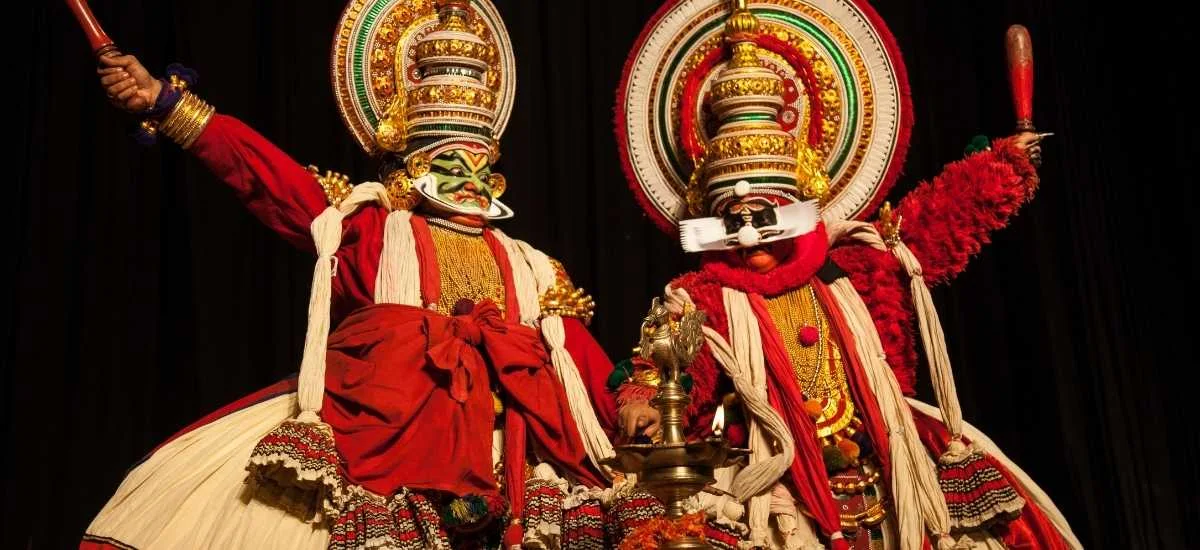
Kathakali is one of the oldest and most visually arresting theatre traditions in the world, originating from the cultural heartland of Kerala, India. A sublime blend of dance, drama, music, ritual, literature, painting, and spiritual philosophy, Kathakali is not merely a performance; it is a living heritage that embodies Kerala’s soul.
The word Kathakali is derived from two Malayalam terms: Katha (story) and Kali (play), literally meaning story-play. Rooted deeply in Hindu mythology, Kathakali performances traditionally narrate episodes from the Ramayana, Mahabharata, and Puranas, bringing epic characters to life through stylised movement, powerful expressions, and elaborate visual symbolism.
Why Kathakali is Unique Among World Theatre Forms
Kathakali stands apart from other classical dance forms due to its highly codified language of expression. Every movement, whether of the eyes, eyebrows, hands, or feet, is governed by strict aesthetic principles developed over centuries. Unlike narrative theatre, Kathakali does not rely on spoken dialogue; instead, stories are communicated through mudras (hand gestures), facial expressions (rasabhinaya), and rhythmic footwork, accompanied by evocative music.
Performed traditionally through the night in temple courtyards under the glow of oil lamps, Kathakali was designed as a spiritual offering, elevating both performer and audience into a shared sacred experience.
Origin and Evolution of Kathakali
Kathakali evolved in 17th-century Kerala, emerging from an earlier dance-drama tradition known as Ramanattam, created by the King of Kottarakkara. Ramanattam focused on stories from the Ramayana and laid the foundation for Kathakali’s narrative and performance structure.
The art form gained depth and maturity under the patronage of the Kottayam royal family, particularly Kottayathu Thampuran, who composed four seminal Kathakali plays based on the Mahabharata. These works helped define Kathakali’s choreography, music, and dramatic grammar.
In the 18th century, Kaplingadu Narayanan Namboothiri refined its aesthetics, while the 20th century saw systematic codification through Pattikkamthodi Ravunni Menon, whose legacy evolved into the renowned Kalluvazhi Chitta, the most widely practiced Kathakali style today.
The establishment of Kerala Kalamandalam at Cheruthuruthy by poet Vallathol Narayana Menon marked a turning point, ensuring institutional training, academic research, and global recognition for Kathakali.
Performance Structure and Techniques
A Kathakali performance is based on a literary text called Attakatha (dance-story). While singers render the verses in a traditional Sopanam style, actors interpret the lyrics entirely through movement and expression.
Key Elements of Performance:
- Abhinaya: Expressive acting using eyes, facial muscles, and gestures
- Nritya: Pure dance sequences with rhythmic footwork
- Nritta: Abstract dance movements
- Mudras: Codified hand gestures (over 500 combinations)
Musical Ensemble:
- Chenda – powerful vertical drum
- Maddalam – bass percussion
- Chengila – metal gong
- Ilathalam – cymbals
- Shankh (conch) and Edaykka for dramatic emphasis
Traditionally, performances lasted all night, announced by Kelikottu (ceremonial drumming). Today, Kathakali is also adapted into shorter stage performances suitable for theatres and cultural venues.
Kathakali Make-Up: The Language of Colours
Kathakali make-up is symbolic and time-intensive, often taking 3-5 hours to complete. The process begins with Theppu (base painting) followed by Chutti, a white, raised jawline structure that enhances facial expressions under lamp light.
Five Major Character Types (Vesham):
- Pacha (Green): Noble, divine heroes like Rama and Krishna
- Kathi (Knife): Anti-heroes with arrogance and aggression
- Kari (Black): Demonic or forest characters
- Thadi (Beard):
- Chuvanna Thadi (Red) – extremely evil beings
- Karutha Thadi (Black) – wild and violent characters
- Vellathadi (White) – virtuous beings like Hanuman
- Minukku: Women, sages, messengers, and gentle characters
Natural pigments and herbal preparations are traditionally used, including special eye applications to accentuate eye movements.
Costumes and Make-Up
Kathakali costumes are monumental and majestic. The lower garment, known as Uduthukettu, is layered to create a massive, circular silhouette. Elaborate headgear resembling crowns is adorned with beads, mirrors, shells, and vibrant colors.
All costume elements, ornaments, and accessories are collectively called Koppu, and managing them is the responsibility of a specialist known as the Pettikkaran.
Designed for performances traditionally staged in temple courtyards and lit by a single coconut-oil lamp, every element, from facial colour to headgear, serves a precise, dramatic, and spiritual function.
During the make-up process, actors lie flat on their backs while specialised artists meticulously paint their faces. This transformation is deliberate and time-consuming, ensuring that the individual performer dissolves into the character. The audience no longer sees the actor; they perceive only the mythological persona being enacted.
The primary objective of Kathakali make-up and costume is to create an aura of the supernatural, aligning the visual experience with the epic narratives drawn from Hindu mythology.
Classification of Kathakali Make-up (Vesham)
Kathakali characters are classified according to their innate moral and psychological qualities. These are expressed through distinct make-up categories, each instantly recognisable to a trained audience.
Pacha (Green) – The Noble Hero
Pacha represents the Dhirodatta, the noble, virtuous, and righteous hero. Faces are painted predominantly green, symbolising purity, balance, and spiritual refinement. Characters such as Rama, Krishna, Arjuna, Bhima, Yudhishthira, Nala, and Rukmangada appear in Pacha vesham.
All Pacha characters wear elaborate headgear called Kiritam. In the case of divine incarnations like Vishnu, Rama, and Krishna, this is replaced by a distinctive crown known as Mudi. While the facial make-up remains identical, Krishna is further distinguished by a dark (often blue-black) jacket, unlike the red or purple jackets worn by other Pacha characters.
Kathi (Knife) – The Hero with Evil Traits
Kathi characters represent royalty tainted by arrogance, ambition, and moral instability. Their make-up closely resembles Pacha but is marked by knife-shaped red slashes on the cheeks, along with small white knobs on the nose and forehead.
This vesham denotes a fusion of nobility and wickedness and is used for characters such as Ravana, Kamsa, and Duryodhana. Unlike Pacha characters, Kathi characters are permitted to emit vocal sounds and aggressive gestures, enhancing their volatile nature.
Thadi (Beard) – Manifestations of Destructive Energy
Thadi represents Tamoguna, the quality of darkness, aggression, and destructive force. It is further classified into three distinct types:
Chuvanna Thadi (Red Beard)
Red Thadi depicts pure, unthinking destruction. The face is painted in dark, frightening colours, complemented by a large red beard and oversized circular headgear. Characters such as Bakasura, Jatasura, and Dussasana appear in this vesham. Symbolic figures like Veerabhadra and the Sudarshana Chakra (Srichakra) are also portrayed using Red Thadi, emphasising annihilation without deliberation.
Karutha Thadi (Black Beard)
Black Thadi represents characters that are not only evil but also scheming and manipulative. The make-up closely resembles Red Thadi, with the crucial distinction being the black beard. A notable example is Kali in Nalacharitam.
Vellathadi (White Beard)
White Thadi is a refined variation, most famously worn by Hanuman, the monkey god of the Ramayana. The intricate patterns in red, black, and white suggest simian features. Hanuman’s headgear, known as Vattamudi, resembles a ceremonial military crown. Given his exalted mythological status, Hanuman is permitted expressive vocalisations and dramatic movement.
Monkey kings such as Vali and Sugriva are also portrayed using modified Thadi patterns, reflecting traditional symbolic hierarchies.
Kari (Black) – The Lowest Order of Evil
Kari is an entirely black costume, used to depict primitive, demonic, and underworld beings. The face, garments, and accessories are all black, and the headgear is minimal and raw. Characters in Kari Vesham communicate through guttural sounds and aggressive movements, evoking fear and chaos.
Minukku – Gentle and Spiritual Characters
Minukku is reserved for gentle, refined, and spiritually evolved characters, including women, sages, Brahmins, messengers, and charioteers. The face is painted in soft yellow or yellow-orange tones, with no Chutti or elaborate costume. Subtle expression replaces grandeur, emphasising inner calm and devotion.
Chutti: Sculpting the Face for Expression
The Chutti, a raised white frame around the jawline, is one of the most distinctive features of Kathakali make-up. Traditionally crafted using rice paste and lime and applied layer by layer over several hours, Chutti today is created using paper for efficiency.
Its purpose is aesthetic and functional: it accentuates facial contours, enlarges the expressive canvas of the face, and directs the audience’s attention to eye and facial movements, especially under low-light conditions.
Kathakali and the Concept of Masks
Kathakali is often mistakenly associated with mask traditions such as Chhau (Bihar) or Balinese dance. However, Kathakali uses no physical masks. The painted face and Chutti may resemble a mask, but they are meticulously handcrafted on the performer’s face for each performance by specialist make-up artists.
The pigments are derived from indigenous mineral stones, ground in coconut oil and mixed with exacting precision. Any imbalance in proportion can cause adverse chemical reactions, making the makeup process both an art and a science.
The Red Eyes: Power and Protection
The striking red eyes of Kathakali performers serve both aesthetic and practical purposes. Visually, they balance the intense facial colours, preventing the eyes from appearing lifeless against dark or green pigments.
Practically, the eyes are treated to counteract the chemical warmth of facial paints. Traditionally, a small herbal seed known as chundappoo is placed in the lower eyelid to induce redness. This process requires extreme care, as incorrect application can be dangerous.
Colour, Emotion, and Aesthetic Theory
While Kathakali does not strictly follow the Rasaprakarana of the Natyasastra, the classical text’s association of colours with emotional states has influenced its visual grammar. Each colour scheme subtly reinforces the emotional and moral essence of the character, enabling audiences to intuitively grasp the narrative even without verbal explanation.
Kathakali costume and make-up together form a sacred semiotic system, transforming human performers into mythic archetypes and elevating theatre into ritual. It is this meticulous visual codification that gives Kathakali its timeless grandeur and unparalleled dramatic power.
Training and Discipline
Becoming a Kathakali artist requires 8–10 years of rigorous training, beginning at a young age. Training includes:
- Body conditioning inspired by Kalaripayattu
- Eye and facial muscle control
- Gesture vocabulary and rhythmic mastery
While Kathakali was traditionally male-dominated, women artists now perform at all levels, contributing significantly to its contemporary evolution.
Where to Experience Authentic Kathakali in Kerala
The best stages for witnessing this beautiful and surreal dance form come alive are scattered all over Kerala. Top destinations include-
- Kerala Kalamandalam, Cheruthuruthy
- Kottakkal Kathakali Sangham, Malappuram
- Sadanam Kathakali Academy, Palakkad
- Margi Theatre, Thiruvananthapuram
- Cochin Cultural Centres & Fort Kochi
Performances are commonly included in Kerala cultural evenings, temple festivals, and curated heritage tours.
Why Kathakali Matters Today
Kathakali is more than performance; it is a philosophical expression of dharma, devotion, and human emotion. Despite modern adaptations, it remains anchored in its sacred origins, continuing to inspire audiences worldwide.
Witnessing Kathakali in Kerala is not just attending a show; it is entering a timeless dialogue between mythology, movement, and the human spirit.
Frequently Asked Questions (FAQs)
1. Is Kathakali difficult to understand for first-time viewers?
Not at all. While the art form is complex, most performances include brief explanations or demonstrations that help audiences appreciate the gestures and expressions.
2. How long does a Kathakali performance last?
Traditionally, Kathakali performances last overnight. However, the modern versions range from 1 to 3 hours. You can catch a live Kathakali performance during your next visit to Kerala
3. Can tourists attend Kathakali performances in Kerala?
Yes. Kathakali performances are open to everyone. They are regularly held in Kochi, Thiruvananthapuram, Thrissur, and major cultural centres.
4. Is Kathakali suitable for children?
Yes, especially short-format performances with explanations and makeup demonstrations.
5. When is the best time to experience Kathakali in Kerala?
October to March is ideal, coinciding with cultural festivals and pleasant weather.